Securing reliable temporary power requires balancing capacity needs against site constraints. Choosing the wrong form factor can lead to noise complaints, damaged equipment, or logistical bottlenecks. For project managers, event organizers, and facility operators, this choice dictates critical site operations. It deeply impacts fuel logistics, site security, and environmental compliance. You must consider how a generator fits into your specific operational footprint. This guide breaks down the operational realities of a trailer generator vs open generator. We provide an evidence-based framework to help you evaluate these options. You will learn how to assess noise limits, runtime requirements, and physical footprint. By the end, you will know exactly which system suits your deployment environment.
Key Takeaways
Capacity vs. Footprint: Trailer generators offer multi-day runtimes and massive power output but require towing logistics and larger site access; open generators excel in high-mobility, tight-space deployments.
Noise & Compliance: Enclosed towable units are essential for noise-sensitive environments (events, livestock shows, residential areas), whereas open frames frequently exceed 80dB, requiring setback distances.
Power Quality: High-end mobile diesel gensets typically provide cleaner power (lower Total Harmonic Distortion) for sensitive electronics compared to standard open-frame contractor generators.
Site Security: Open-frame units are highly susceptible to job site theft, while trailer generators offer lockable panels and hitch/wheel immobilization options.
System Architecture: Towable Generators vs. Open Frame Models
The Trailer Generator
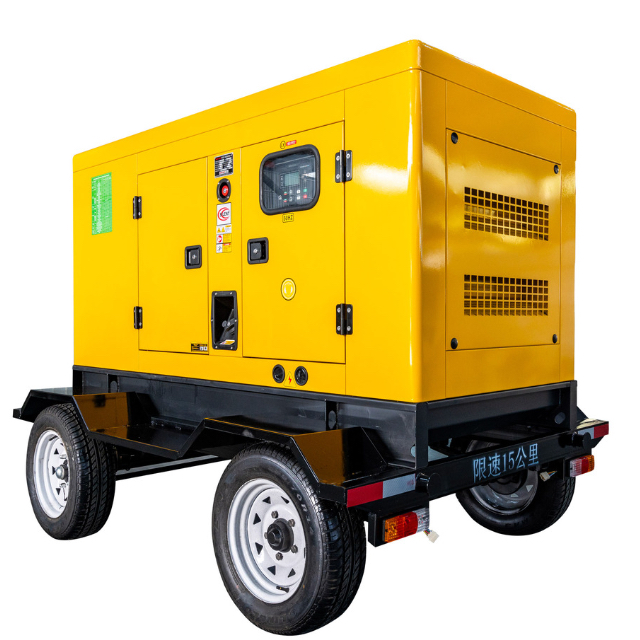
Industry professionals often classify this unit as a mobile diesel genset. We define it as a heavy-duty alternator and engine permanently mounted to a DOT-compliant chassis. Core components include integrated large-capacity fuel cells. They feature weather-resistant acoustic enclosures. You will also find commercial-grade distribution panels inside. The primary advantage is clear. Engineers design them for sustained, unattended operation. They allow seamless highway transport via a standard hitch setup.
The Open Generator
We define this as an exposed engine and alternator. Manufacturers mount them inside a protective tubular steel roll cage. Core components differ significantly from larger models. They use gravity-fed top-mounted gas or diesel tanks. They feature standard duplex or twist-lock receptacles. Wheel kits allow for manual positioning by site workers. The primary advantage is the maximum power-to-weight ratio. It acts as an easily deployable unit. You can lift it into truck beds. You can navigate it through narrow doorways quickly.
Performance and Power Quality Under Load
Runtime and Fuel Management
Power output tells only half the story. You must evaluate runtime limits carefully. Let us analyze the discrepancy in fuel capacity. A large towable unit holds substantial fuel. It often holds enough diesel for 24 to 48 hours. This assumes continuous runtime at half load. Contrast this performance against smaller portable frames. An open diesel generator typically requires refueling every 8 to 12 hours. Gas models behave similarly. Frequent refueling creates serious labor overhead. It interrupts continuous operations on busy job sites.
Total Harmonic Distortion (THD) and Equipment Safety
You must examine power cleanliness before plugging in devices. Standard open-frame generators often produce higher THD. This usually exceeds 5 percent. Dirty power damages sensitive electronics rapidly. It harms audio gear, medical equipment, and server racks. Large trailer generators perform much better. They usually feature robust voltage regulation. They maintain low THD levels. This makes them safer for complex event production. It also ensures safe facility backup.
Performance Comparison Chart
Feature
Trailer Generator
Open Generator
Average Runtime (Half Load)
24 to 48 hours
8 to 12 hours
THD (Power Cleanliness)
Under 5% (Clean)
Over 5% (Fluctuating)
Refueling Labor Overhead
Very Low
High (Multiple daily shifts)
Environmental Compliance: Noise Limitations and Weather Protection
Sound Attenuation vs. Raw Acoustic Output
Site rules dictate equipment choices strictly. You must account for noise and weather. Real-world noise constraints affect operations everywhere. Consider campground etiquette and local ordinances. OSHA job site regulations apply strictly. Livestock shows require low stress for animals. Trailer units address these issues directly. They feature thick sound-dampening enclosures. They often reduce noise to 65–70 dB at 23 feet. Open frames lack acoustic paneling entirely. They frequently run between 75 and 85+ dB. They require physical distance. You might need aftermarket baffles to remain tolerable.
Weather Readiness
We must assess environmental exposure immediately. You need a reliable outdoor power solution. Trailer generators arrive inherently weatherproofed from the factory. You can stage them outdoors long-term. Open generators lack this vital defense. They expose sensitive components to the elements. Rain and dust threaten air filters and outlets. You must deploy temporary generator tents. Shelters ensure safe operation during foul weather.
Logistics and Site Security
Deployment and Mobility
Movement and protection define daily operations. Transporting power requires careful planning. Evaluate the transport reality first. A towable generator requires a dedicated vehicle. You need proper towing capacity. The site must allow access for backing in. Open frames offer more agility overall. One or two personnel can maneuver them. They handle rough terrain reasonably well. They remain ideal for fragmented job sites.
Risk Consideration
Site security presents a major challenge today. Open generators act as notorious targets. Thieves prefer quick "lift and run" theft. Job sites suffer these losses frequently. Trailer units deter casual theft naturally. They require deliberate towing effort. Operators secure them using heavy-duty hitch locks. Wheel immobilization adds another defense layer. Lockable control panels prevent unauthorized tampering.
Decision Framework: Selecting Your Temporary Power Supply
Matching equipment to site needs prevents catastrophic failures. Use this evaluation framework to decide appropriately.
When to Choose a Trailer Generator:
Your power demands exceed 15kW to 20kW.
Applications include commercial construction sites and outdoor festivals.
You need emergency facility backup or prolonged off-grid operations.
Strict noise ordinances govern your operating location.
Applications include residential backup, power tools, and agricultural repairs.
Noise limitations do not restrict your daytime operations.
You can secure the equipment indoors every night.
Conclusion
The decision between a trailer generator vs open generator is rarely about just watts and volts. It is about deployment logistics, noise tolerance, and runtime demands. If your priority is a highly portable power source for daytime manual labor, the open generator suffices. If you require stable, continuous, weatherproof, and compliant power for mission-critical operations or public events, the investment in a towable generator is objectively justified.
Consider these actionable next steps to finalize your deployment strategy:
Calculate your peak wattage requirements before securing rental or purchase agreements.
Review local noise ordinances to avoid operational shutdowns during off-hours.
Assess your site layout to ensure adequate access for towing vehicles.
Develop a daily refueling schedule if opting for smaller, open-frame units.
FAQ
Q: Can I run sensitive electronics on an open generator?
A: Only if the unit specifies a THD of less than 5%. Otherwise, a power conditioner or an inverter-based/commercial trailer unit is required to prevent damage.
Q: Do trailer generators require a specialized license to tow?
A: Most temporary power trailers fall under standard weight limits. However, units exceeding 10,000 lbs (GVWR) may require commercial licensing or specific hitching classifications depending on local jurisdiction.
Q: How do I secure an open diesel generator against theft?
A: Utilize heavy-duty chains attached to immovable structures. Remove wheel kits when the unit remains stationary. Lock the unit inside a secure container or building overnight.
Q: Can an open frame generator be enclosed to reduce noise?
A: Yes, you can use specialized baffle boxes or aftermarket enclosures. However, users must rigorously manage airflow to prevent catastrophic engine overheating and dangerous exhaust hazards.
DONGCHAI POWER devotes itself to manufacuring and maintenance of different types generator, diesel generator, gas generator, silent generator, reefer generator, container generator and sychronization generator.