Introduction
Power outages, natural disasters, or remote locations can leave you without electricity. A generator can ensure your home stays powered, but choosing the right size is crucial. In this article, we’ll discuss how to determine the ideal generator size for your home. You’ll learn how to avoid common mistakes and select the right generator to meet your needs.
Understanding Generator Sizing: Why It Matters for Homeowners
Why Generator Size Is Crucial
A properly sized generator can keep your home functional during a power outage. However, choosing the wrong size generator can lead to problems. If your generator is too small, it won't power all of your critical appliances. If it’s too large, you'll end up spending more on fuel and maintenance than necessary.
Key factors to consider when sizing a generator include:
● Total wattage: The amount of electricity needed for all essential appliances.
● Load: The total power drawn by all devices running at the same time.
● Appliance types: Different appliances require different amounts of power, so understanding the power needs of each is essential.
How to Calculate Your Home's Power Needs
Calculating your home's power needs involves two main steps:
1. Identify your appliances: List all appliances you wish to power during an outage (e.g., fridge, lights, HVAC).
2. Determine wattage requirements: Every appliance has a running wattage and a surge wattage (the power needed to start the appliance). It's important to factor in both.
For example:
● A refrigerator may require 600 watts to run but could need 1,200 watts to start.
● A microwave might need 1,000 watts to operate but 2,000 watts for startup.
By calculating the running wattage and surge wattage for each appliance, you'll get a clear picture of your home's total power needs.
Common Mistakes When Sizing a Generator
Many homeowners make the mistake of overestimating or underestimating their power needs. Common mistakes include:
● Underestimating surge wattage: Ignoring the startup wattage needed for appliances like refrigerators, air conditioners, or pumps can result in a generator that's not powerful enough to handle demand.
● Overestimating power needs: Some people add up the wattage of every appliance and assume they'll run all at once, leading to the purchase of an overly large generator that wastes fuel.
Tip: Always account for both running and surge wattage to ensure your generator can handle your home’s full load.
What Size Generator Will Run a Home? (A Comprehensive Guide)
Small Homes vs. Larger Homes: What’s the Difference?
The size of your home directly impacts the size of the generator you need. Smaller homes typically require less power, while larger homes need more. Here's how it breaks down:
Home Size | Recommended Generator Size | Appliances Powered |
Small Homes (Under 1,500 sq. ft.) | 3,000 to 4,000 watts | Essential appliances like lights, refrigerator, TV |
Medium Homes (1,500 - 2,500 sq. ft.) | 5,000 to 7,500 watts | HVAC system, lights, fridge, small appliances |
Large Homes (Over 2,500 sq. ft.) | 10,000+ watts | Multiple HVAC units, large appliances, water heater |
Key Factors Affecting Generator Size
Several factors influence the size of the generator you need:
1. Number of appliances and wattage: The more appliances you need to power, the larger the generator.
2. Energy-efficient appliances vs. older models: Newer, energy-efficient appliances typically consume less power. If your appliances are older, you may need a larger generator.
Note: Don't forget to account for the specific power needs of essential systems, such as HVAC or water heaters, as these often require significant wattage.
Choosing Between Portable and Standby Generators
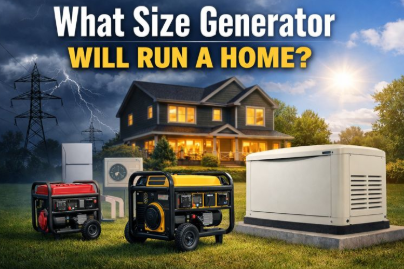
Generators come in two primary types: portable and standby.
● Portable generators are typically less expensive and offer flexibility since they can be moved around. However, they require manual setup and may not be as powerful as standby options.
● Standby generators are permanently installed and automatically turn on during a power outage. While they tend to be more expensive, they can handle larger loads and are more convenient for homeowners who need continuous power.
For a small to medium home, a portable generator might be sufficient, but larger homes or homes with extensive electrical needs will likely benefit from a standby generator.
Step-by-Step Process for Choosing the Right Generator Size
Step 1: List Your Essential Appliances
The first step in sizing your generator is identifying the appliances you want to power during an outage. Critical systems often include:
● Refrigeration (fridges, freezers)
● HVAC systems (heating and cooling)
● Lighting (interior and exterior lights)
● Medical equipment (if applicable)
Tip: Make a detailed list of your most essential appliances and their power requirements. Prioritize based on necessity in an outage.
Step 2: Calculate Total Wattage Requirements
Now that you’ve listed your appliances, you’ll need to calculate the total wattage required to run them all. This involves:
1. Listing the running wattage for each appliance.
2. Adding surge wattage for devices with motors or compressors (e.g., refrigerators, AC units).
For example:
● A fridge needs 600 watts to run and 1,200 watts to start.
● An air conditioner needs 2,000 watts to run and 3,000 watts to start.
Add all running wattages and surge wattages to determine your generator's required output.
Step 3: Determine the Generator Capacity
Once you’ve calculated the total wattage, choose a generator that can handle both running and surge wattage. For example, if your total running wattage is 4,000 watts and your surge wattage is 6,000 watts, a generator rated for 6,000 watts would suffice.
Step 4: Consider Fuel Type and Runtime
Generators run on various fuels, including gasoline, propane, and diesel. The fuel type impacts your generator's runtime and convenience.
Fuel Type | Advantages | Disadvantages |
Gasoline | Readily available, easy to find | Shorter runtime, requires frequent refueling |
Propane | Longer shelf life, cleaner emissions | Requires storage space for propane tanks |
Diesel | Longer runtime, more fuel-efficient | More expensive, noisier, fuel harder to find |
Tip: Consider how long you expect your generator to run and whether fuel availability is a concern in your area.
Generator Sizing Examples for Different Household Needs
Small House (Under 1,500 sq. ft.)
A small home typically requires 3,000 to 4,000 watts. This will power essential appliances, including:
● Lights (500-1,000 watts)
● Refrigerator (600 watts)
● TV and small devices (400 watts)
Medium House (1,500 - 2,500 sq. ft.)
For a medium-sized home, you’ll likely need 5,000 to 7,500 watts to power:
● HVAC system (2,000-4,000 watts)
● Refrigerator (600 watts)
● Additional appliances (1,000 watts)
Large House (Over 2,500 sq. ft.)
A large home may need a 10,000+ watt generator to power:
● Multiple HVAC units (4,000 watts)
● Large appliances (3,000 watts)
● Kitchen devices, water heaters, and other large systems (3,000 watts)
Additional Tips for Selecting the Right Generator
Consider Automatic Transfer Switches (ATS)
For convenience and safety, consider installing an automatic transfer switch (ATS) with your generator. This allows the generator to start automatically when the power goes out, ensuring uninterrupted power without manual intervention.
Maintenance and Longevity of Your Generator
Proper maintenance ensures your generator lasts longer. Regular servicing, such as oil changes, air filter cleaning, and battery checks, is essential to keep your generator running smoothly.
Note: Keep your generator in a dry, well-ventilated space to prevent rust and other damage.
Safety Tips for Using a Home Generator
● Proper installation: Always install your generator according to manufacturer guidelines to prevent dangerous situations like carbon monoxide buildup.
● Outdoor use: Never run your generator indoors or in an enclosed space.
● Fuel storage: Store fuel in approved containers away from heat sources.
Conclusion
Choosing the right size generator for your home is crucial for ensuring you can power essential appliances during an outage. It’s important to carefully assess your home's power needs, whether you’re dealing with a small, medium, or large home, and whether you need a portable or standby generator. By calculating the total wattage and surge wattage for your essential appliances, you can avoid costly mistakes and choose a generator that fits your needs without overpaying or underpowering your home.
Tip: Always plan ahead—knowing the generator size that suits your needs will help you stay prepared during emergencies without wasting money. Consider reaching out to trusted manufacturers and suppliers like Fuan Dong Chai Power Co., Ltd., who can guide you in selecting the right generator for your specific needs.

FAQ
Q: What size generator do I need to run a home?
A: The size of the generator depends on your home's size and the number of appliances you need to power. Small homes typically require 3,000 to 4,000 watts, while larger homes may need 10,000 watts or more to run essential systems like HVAC and kitchen appliances.
Q: How do I calculate the wattage for a generator?
A: To calculate the wattage for a generator, add up the running wattage and surge wattage of all appliances you want to power. Be sure to consider both steady power consumption and the extra power needed to start certain appliances like refrigerators or air conditioners.
Q: Why is it important to choose the right generator size?
A: Choosing the right generator size ensures that all essential appliances run efficiently during a power outage. An undersized generator will struggle to power your home, while an oversized one wastes fuel and costs more.
Q: Can a portable generator power my entire house?
A: A portable generator can power essential appliances in smaller homes, but larger homes with multiple appliances may require a standby generator for continuous power. It's essential to calculate your home's wattage needs before deciding.